
FTC Rules for YouTubers: Why Transparency Builds Trust
YouTube creators often face a choice between fast growth and long-term trust. This post explains why FTC disclosure rules matter, how blurred sponsorships erode credibility, and why transparency is the only path that sustains creators, audiences, and platforms over time.
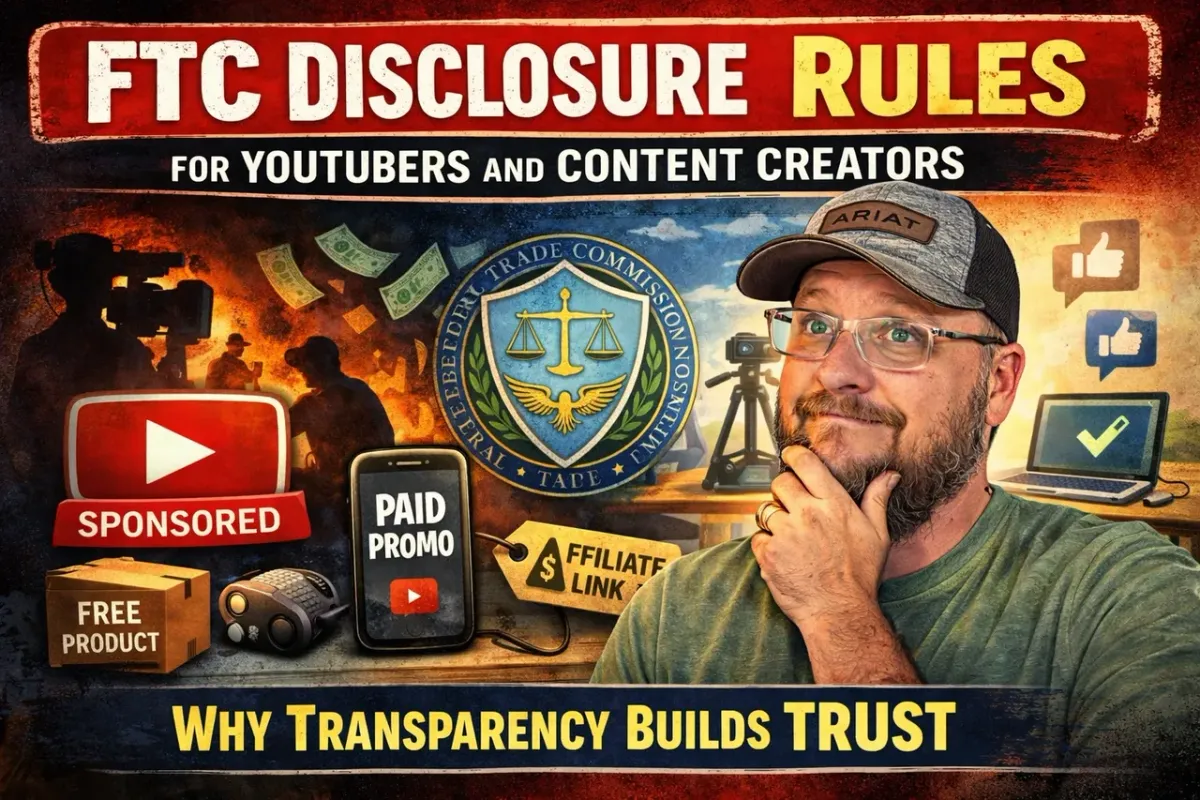
If you spend any amount of time on YouTube, you have probably noticed two very different paths creators take.One path is fast, flashy, and endorsement heavy. It prioritizes growth, polish, and brand friendliness. The other path is slower, more transparent, and far less exciting on the surface.I believe the second path is better for everyone involved: the consumer, the creator, and the platforms that host the content.The FTC rules matter far more than most creators want to admit. Ignoring them can absolutely accelerate short-term growth, but it quietly erodes trust over time. And once trust is gone, no amount of subscribers, polish, or production budget brings it back.Platforms survive because people come back. And people come back because they trust what they are watching.
Why the FTC Exists in the First Place
The Federal Trade Commission exists for one simple reason: to prevent consumers from being misled.Section 5 of the FTC Act prohibits unfair or deceptive acts or practices in commerce. That applies to banks, companies, advertisers, and it applies just as much to YouTubers and creators. At its core, deception is not about whether someone tells an outright lie. It is about whether a reasonable viewer could be misled by:
- What is said
- What is implied
- What is omitted
If a creator is paid, gifted, incentivized, or otherwise influenced by a brand relationship, and that context is not clearly disclosed, the FTC considers that information material. Material simply means it matters to a viewer’s decision.The FTC makes this clear in Section 5 of the FTC Act, which defines deceptive practices as representations or omissions that are likely to mislead a reasonable consumer and influence their decision making .
Where Things Start to Break Down on YouTube
This is where my frustration comes in.Over time, I have observed content involving brands like Ruroc and Insta360 where, in my view, the presentation blurred the line between independent reviews and paid promotion from a viewer’s perspective. The issue is not that creators worked with these companies, it is how often that content was presented in ways that appeared:
- Organic
- Unscripted
- Personal
- Experience-driven
…while viewers (like myself) may not always been clear of the underlying material relationship.I am not alleging illegal behavior. I am describing a pattern I have personally observed as both a viewer and a creator, and the effect that pattern has on audience trust.The problem is not sponsorships.The problem is opacity.When a viewer cannot reasonably tell whether a glowing review exists because a product is genuinely good or because the creator is financially or contractually incentivized, trust begins to erode.That erosion is slow, but it is relentless.
The Illusion of Authenticity Is Still Deception
The FTC does not evaluate intent. It evaluates impact.Specifically, it asks whether a reasonable viewer could be misled. If a brand relationship exists and that relationship is not clearly disclosed, the omission itself can be deceptive. Especially when the content is presented in a way that would reasonably lead a viewer to believe it is personal, unbiased, or purely experience-driven.The FTC explicitly recognizes omissions as a form of deception when disclosure is necessary to prevent consumers from being misled.Looking authentic is not the same thing as being transparent.
Short-Term Growth vs Long-Term Health
This is the uncomfortable part for creators.Yes, endorsement-heavy channels can grow very fast.Yes, polished and brand-friendly narratives convert well in the short term.Yes, it can feel like the system rewards creators who play along.But I have watched this pattern repeat itself more than once.
- Creators build massive audiences quickly
- Engagement starts to decline
- Comment sections shift from curiosity to skepticism
- Viewers stop trusting recommendations
- Influence fades, even if subscriber counts remain high
That outcome is not a mystery. It is the predictable result of diluted trust.Trust is a finite resource. Once it is spent, it is incredibly difficult to earn back.
Why This Matters to Platforms Too
This conversation is not just about creators and brands. It is about platform health.YouTube, and platforms like it, do not survive because of spectacle alone. They survive because people come back day after day believing the content has integrity.Audiences can enjoy high-production stunts, viral moments, and big-budget entertainment from creators like MrBeast or WhistlinDiesel. There is nothing inherently wrong with spectacle. But platforms cannot be built solely on escalation, excess, or shock value. Long-term loyalty is built on trust, not on who can destroy the most expensive object or spend the most money on a single video.
Why I Take FTC Compliance Seriously
There is a reason I include the statement “Gears & Gadgets abides by all requirements in Section 5 of the FTC Act (15 U.S.C. 45) regarding the use of endorsements and testimonials in advertising.” at the bottom of every email I send.That line is not performative. It is a reminder, to brands and to myself, of how I operate. It sets expectations up front and establishes boundaries early. Most importantly, it filters out partnerships that are not aligned with transparency.
Not All Monetization Is the Same
Another area that often gets oversimplified is how creators actually get paid.Not all brand relationships are equal, and they are not all disclosed the same way.For example:
- Product provided for free is different from a paid sponsorship
- A paid ad read is different from long-term affiliate marketing
- Affiliate links do not mean editorial control, but they still require disclosure
Each of these relationships carries different expectations, different incentives, and different disclosure requirements.I will be breaking these down in detail in a future post so creators and viewers alike can better understand the differences.
How I Try to Operate
My personal standard is simple.
- If something is sponsored, gifted, discounted, or affiliate linked, I disclose it clearly
- If a company attempts to restrict criticism, dictate conclusions, or limit disclosure, I walk away
- If a product is good, I will say so
- If it is not, I will say that too, or I will not publish the content at all
This approach is slower.It is less sexy.It sometimes costs opportunities.But it builds something far more valuable than short-term growth.It builds credibility.
The Uncomfortable Truth for Brands and Creators
- The FTC rules are not killing creativity.- Audiences are far more perceptive than they get credit for.- They notice patterns.- They notice tone shifts.- They notice when every product suddenly becomes “game changing.”- The creators who last are not the loudest.- They are the most consistent.- They are the most transparent.- They treat trust as the product, not the byproduct.