Why the BEST Tonneau Cover May Be the WORST
I’ve reviewed 8 tonneau covers over the last decade, and there is no single “best” option, only tradeoffs. This article cuts through the noise to explain how design choices affect security, durability, usability, and cost so you can choose what actually fits your truck.
After reviewing 8 different truck bed covers over the last decade, one thing has become very clear.
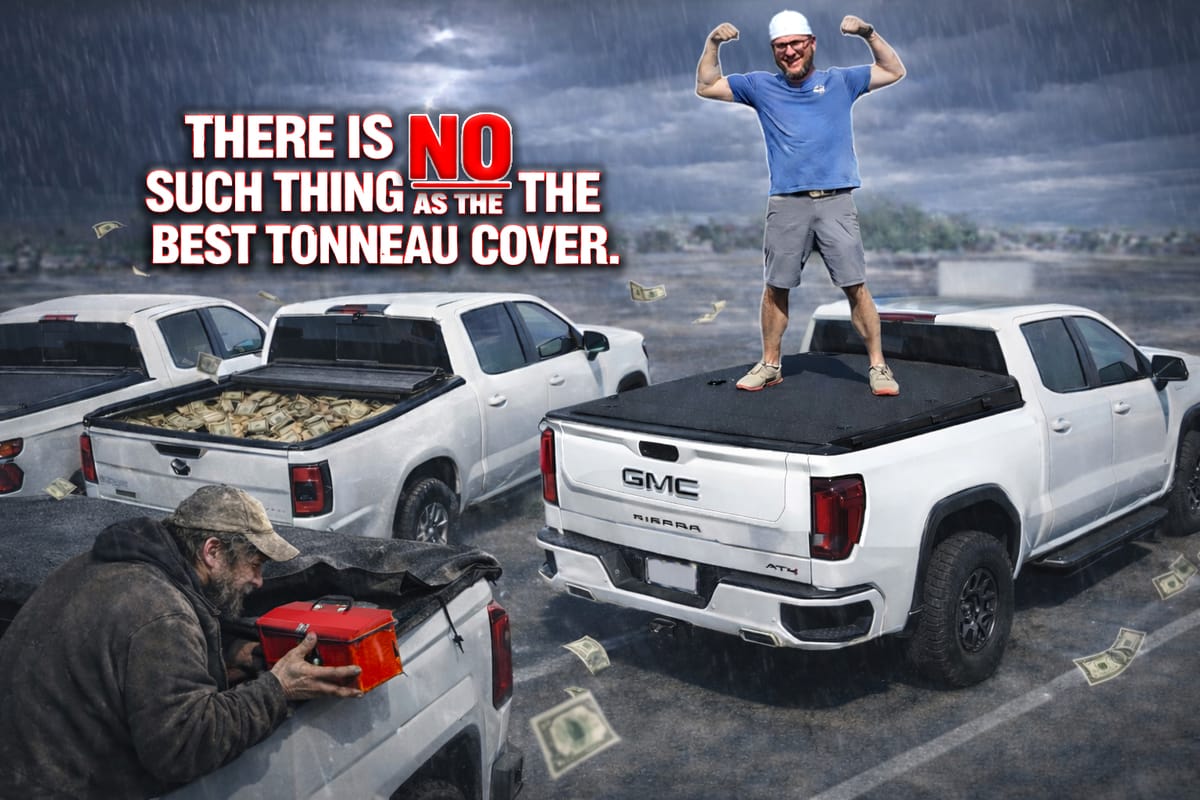
There are always tradeoffs driven by design choices. What might be the best option for you could easily be the worst choice for someone else.
Now let’s be clear. I have, and will continue to, ask the question “What’s the best tonneau cover?” in thumbnails and titles because SEO is real, and pretending otherwise would be dishonest. But if you actually watch my videos, one thing I remain proud of is getting into the nuance. I focus on honest conversations about how these covers are engineered, why they exist, and who they actually make sense for.
This post brings together every tonneau cover I have reviewed on the Gears & Gadgets YouTube channel, not to crown a winner, but to give you the context most product pages never provide.
Collectively, these reviews have generated well over 2 million views, and somewhere along the way, by installing, using, testing, and living with these covers myself, I have become a bit of a tonneau cover expert. Not because I claim to know everything, but because I have spent years having the same conversations, answering the same questions, and watching the same tradeoffs play out in the real world.
If you are shopping for a tonneau cover and feeling overwhelmed, this is the missing context meant to cut through the noise.
How I Test Tonneau Covers
Before getting into specific models, it is important to understand how I approach testing.
Every tonneau cover I review is installed by me. I have never had a shop install one. That is intentional. I want to experience what the average person experiences when a cover shows up at their house, gets opened in the driveway, and has to be installed with basic tools.
While I have become more efficient at installing tonneau covers over the years, the goal is still to reflect what a real-world DIY install actually feels like.
My reviews focus heavily on:
- Installation difficulty and instructions
- Day-to-day operation and usability
- Construction quality and durability
- Bed access
I also place a lot of emphasis on water testing using 360-degree cameras mounted inside the bed during automated car washes. This allows me to go back in post-production and watch every inch of the cover to see exactly how it performs, and more importantly, to show you where it does or does not leak.
This matters because automated car washes use ultra-pressurized water from above and the sides, which is often far more aggressive than rain or highway spray. If you ever find yourself driving in conditions that match that level of water pressure, you have probably driven straight into a typhoon and the waterproofing of your truck bed is likely the last thing on your mind. But if a cover struggles here, it still tells you something worthwhile.
The Engineering Tradeoffs Every Cover Makes
Before talking about specific models, it helps to frame the conversation properly.
Every tonneau cover design sits somewhere on six competing priorities:
- Theft resistance
- Durability and longevity
- Appearance and profile
- Ease of operation and access
- Waterproofing
- Cost
You cannot maximize all of these at the same time. If a cover excels in one area, it almost always compromises another. Once you accept that reality, choosing the right cover becomes much easier.
Real-World Example: When Waterproofing Actually Matters
One person might harp endlessly on how waterproof a cover is. Personally, I often think that conversation is overblown. If you are storing highly sensitive items in a pickup bed, they should probably already be in waterproof cases. Or maybe you should own a Suburban instead.
But then reality sets in.
That person might be a volunteer firefighter or EMT with medical equipment in the bed of their truck. They may need that equipment secured, protected from the elements, and not rolling around or becoming projectiles in an accident. Suddenly, waterproofing and security become very real priorities.
The same logic applies to cost.
I have seen people dismiss expensive covers as silly or overpriced. My counter is simple. There have been times when I had well over $15,000 worth of specialty construction technology or camera equipment in my truck bed.
Protecting that equipment is not just about replacement cost. Even if insurance covers the loss, it does not cover reputational damage. Missed jobs and schedule impacts can be far more costly than the gear itself.
That logic does not apply to someone who just wants a $300 fabric cover to keep some Harbor Freight tools out of sight. Both use cases are valid.
This raises an important question.
Do you need Fort Knox, or do you just need something that reduces crimes of opportunity?
Out of sight, out of mind is very real. No tonneau cover attracts the stickiest fingers on its own. A cheap fabric cover can be enough to reduce crimes of opportunity simply by hiding what is in the bed, but it is easily defeated by curiosity. Velcro or snaps can be lifted to peek inside, and a razor blade makes quick work of the material if something valuable is spotted.
By contrast, a full aluminum cover raises the bar significantly. Getting into one typically requires an angle grinder and a willingness to create a lot of noise and attention, all in the hope that there is something worth stealing inside that cannot be verified beforehand.
Wear, Tear, and Realistic Expectations
Another reality is wear and tear. These covers live in the sun and snow, face upward, and take constant abuse. Most will show wear around the five-year mark, which is completely normal. Complaints about how terrible a cover looks ten years later are often rooted in unrealistic expectations.
The big exception is painted, color-matched fiberglass covers. Those can last a very long time when properly cared for. I do not cover those here because I have never reviewed one, and realistically, most people shopping for tonneau covers are not buying them anyway. Most tonneau covers are going on working trucks, not show trucks, where tools, materials, and gear get tossed on top throughout the day.
Acknowledging Bias (Including My Own)
I always recommend reading reviews and watching as many videos as possible, not just mine. Even with genuine relationships with companies like RealTruck and various manufacturers who never tell me what to say, bias can still creep into any review. That is true across the entire internet, not just YouTube.
There is also confirmation bias on the buyer side. People naturally want to love what they already purchased, and that can color how products are discussed and defended online. We all know that guy at work who rants and raves about how incredible the thing he bought is. Odds are, if he had bought the competing product instead, he would be just as convinced that one was the best.
This article may contain affiliate links. If you click a link and make a purchase, I may earn a commission at no additional cost to you. Those links do not influence my opinions or conclusions. Every cover discussed here was installed, used, and tested by me in real-world conditions.
I try to be as honest as possible, but I am still human.
Hard Folding and Rolling Covers: Security and Structure With Compromises
Hard covers dominate the market for a reason. They strike one of the strongest overall balances between security, weather resistance, appearance, and usability.
BAK Revolver X4s
The BAK Revolver X4s remains one of the most impressive designs I have tested and checks more boxes than almost anything else I have used. The aluminum slat construction provides real theft resistance while still rolling forward instead of folding upward, allowing nearly full bed access without completely blocking the rear window. The thumbscrews allow the cover to be removed entirely if needed, though carrying it can be painful if you are not careful. Those aluminum slats are pinchy.
The vinyl top gives it a classic look while the aluminum slats prevent flapping and keep the profile extremely low. Maintenance matters here. In Phoenix, UV exposure is brutal. Using 303 Aerospace Protectant every four to six weeks has kept mine looking great.
For me, this cover sits firmly in the top three I have ever tested, and arguably number one.
There is also an X4ts version with T-slots for accessories.You can check that out here.
BAKFlip MX4 Gen 3
The BAKFlip MX4 Gen 3 uses full hard panels with excellent fit and finish and strong security. The tradeoff is partial rear window obstruction when folded. That may not matter to you, or it may be a dealbreaker.
LEER HF650M
he LEER HF650M pushes further into rigidity and a clean OEM-style appearance. It feels solid and well built, but quad-fold designs introduce more seams, hinges, and potential long-term wear points than rolling designs.
Hard folding and rolling covers are ideal if:
- Theft resistance matters
- You want a clean factory-style look
- You are willing to trade some convenience for strength
Fabric Roll-Up Covers: Simplicity, Speed, and Real-World Usability
Fabric roll-up covers are the simplest tonneau covers available, and that simplicity is their strength. Lightweight materials and minimal hardware make them easy to install, easy to use, and easy to live with.
They are not built for security. A fabric cover can be lifted at the Velcro or snaps to see what is in the bed and cut quickly with a razor knife if something valuable is spotted. That does not make them bad products. It simply defines the tradeoff.
For many owners, their value is convenience, basic weather protection, and reducing crimes of opportunity.
LUND Genesis Elite Roll-Up
Roll-up covers represent a very different philosophy. Fewer moving parts, simpler materials, lower cost, and extremely fast operation.
They are not designed to stop a determined thief. They are designed to keep things dry, improve aerodynamics, and make daily use effortless. For trucks that live in garages or lower-risk environments, this category makes more sense than many people expect.
Roll-up covers are ideal if:
- You want fast, one-handed operation
- Cost matters
- Simplicity matters more than maximum security
Electric and Retractable Covers: Convenience Comes at a Price
Retractable covers sit at the high end of convenience and security, but they require the most honesty about how you actually use your truck. The push-button operation and premium feel are undeniable, but the tradeoff is lost bed space due to the canister.
For many owners, especially those who rarely load large toys like quads or motorcycles, a 5.5-foot bed still handles real-world tasks like lumber runs and daily hauling just fine. When it comes to truly heavy loads, a trailer is almost always the smarter choice anyway.
These covers tend to appeal to buyers who have the budget to prioritize convenience and style. Some see them as overpriced. Others see them as worth it.
Roll-N-Lock E-Series
The Roll-N-Lock E-Series is one of the most impressive pieces of engineering I have installed. Push-button operation is genuinely convenient, and the aluminum construction provides solid theft resistance.
The tradeoffs are unavoidable. The canister takes up bed space. Cost is significantly higher. More components introduce more long-term complexity.
Retrax EQ
The Retrax EQ pushes this concept even further with premium materials and an even higher price point. At over $3,000, the question shifts from “Is it good?” to “Is it worth it for how I use my truck?”
Retractable covers are ideal if:
- Convenience is your top priority
- Cost is secondary
- You are okay giving up some bed space
Specialty and Extreme-Duty Designs
Specialty and extreme-duty tonneau covers exist for very specific use cases where security matters more than convenience or subtlety. These designs prioritize strength, load-bearing capability, and controlled access above all else.
This category starts to overlap with service truck tool bodies. They are often chosen by people who carry high-value or sensitive items that cannot be accessed by anyone other than the owner.
Paragon Tectonic
The Paragon Tectonic series is one of the top three tonneau covers I have tested because it is very honest about what it is designed to do.
It is built for maximum strength, modularity, and structural capability. It is heavy. It is expensive. It is not subtle.
Those are not flaws. They are intentional engineering decisions.
Peragon Landmark
The Peragon Landmark is a smart design on paper, but in practice it ended up being one of my least favorite covers. It retracts quickly, preserves rear visibility, and can be removed easily, but it never inspired confidence in long-term rigidity or security.
It lives in an awkward middle ground. More complex than a roll-up, less capable than ultra-duty covers.
DiamondBack Covers
DiamondBack is one of the most requested covers I have been asked to review, and I have not had hands-on time with one yet. Based on design and owner use, it appears to sit squarely in the ultra-duty category alongside covers like the Tectonic.
That is exactly why I want to get my hands on one.
What Reviewing All of These Covers Taught Me
Every tonneau cover I have reviewed has been the best choice for someone. None have been the best choice for everyone.
If you want deep, real-world breakdowns including installation, day-to-day operation, long-term use, and 360-degree car wash water testing, every tonneau cover discussed here is playlist on the Gears & Gadgets YouTube channel: