Why Air Bags Are the Most Practical Truck Mod for Towing and Hauling
If you tow or haul regularly, air bags fix truck squat, improve stability, level headlights, and make your truck safer under load. They do not increase payload capacity, but they are one of the most practical upgrades you can make.
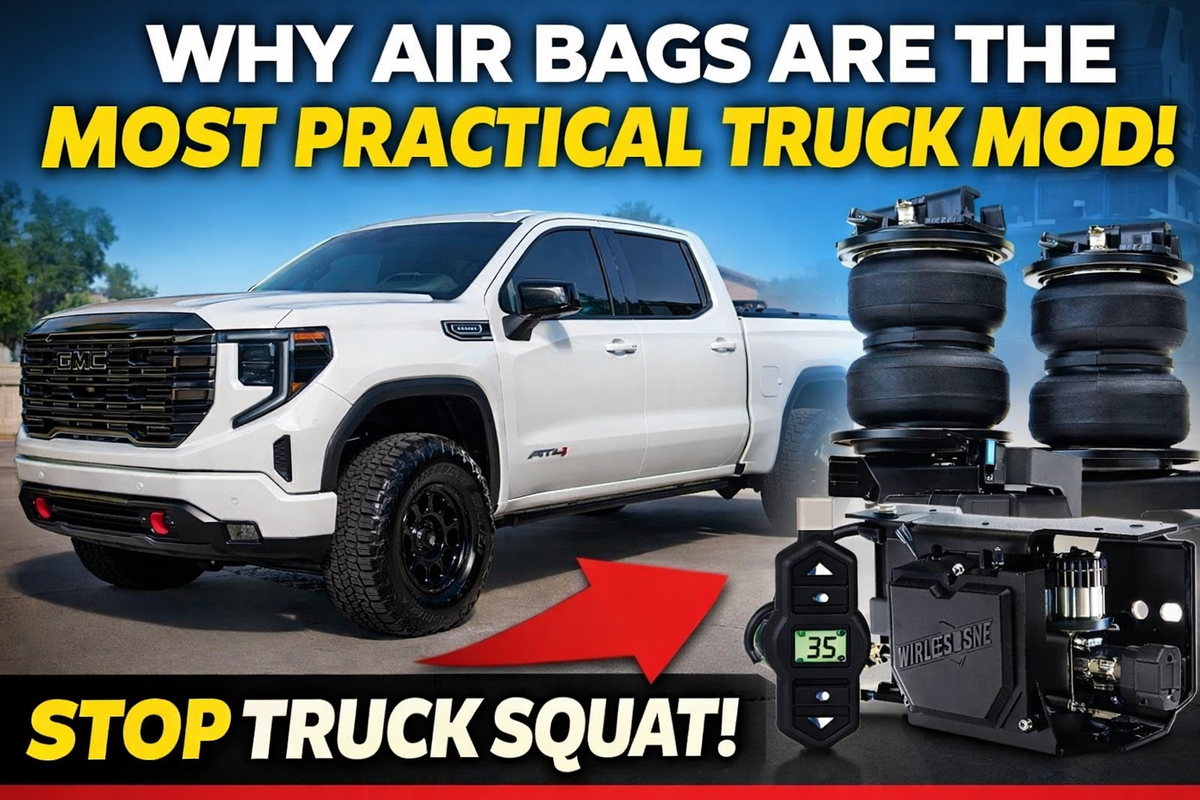
If you tow or haul and deal with truck squat, air bags are one of the most effective and practical upgrades you can make to restore ride height, improve stability, and make your truck safer under load.
Trucks come from the factory with the front end sitting lower than the rear. That rake is intentional. Once a truck is loaded, it naturally levels itself out or squats slightly in the rear, which is exactly how trucks are designed to work.
Like a lot of truck owners, I leveled the front of my truck because it looks better day to day. The problem is that leveling the front works directly against the original intent of the suspension. Once you level the front and then put a load on the truck, the rear now sits even lower than it ever would have from the factory.
This creates real issues. Steering gets lighter. Braking gets worse. Headlights tilt upward and blind oncoming drivers. The truck feels less confident and less controlled under load.
Truck squat drives me nuts. It makes your truck look weaker than it actually is. It looks like someone who skips leg day. Yes, there are people who intentionally modify their trucks to look like they are struggling to carry their own unloaded weight, but that makes no sense. It does not look tough. It just looks like something is broken.
After installing air bags and actually using them the way they are intended, it became clear that this is one of the most practical upgrades you can make if you tow or haul with any regularity.
"Just Buy a Bigger Truck” Misses the Point
Any time air bags come up, there is always that guy. The one who tells you that if your truck squats, you should have bought a Cummins 3500 dually instead. That advice ignores how trucks are actually used in the real world.
Even the heaviest duty trucks start to squat once you approach roughly half of their rated capacity. It does not matter how tough the badge is or how big the numbers look on paper. Load is load, and suspension physics do not care about internet opinions.
Air bags have a place on half-ton, three-quarter-ton, and one-ton trucks. They are not a band aid for buying the wrong truck. They are a tool for managing load within the truck you already own.
I am not suggesting buying any truck and running it at 100 percent of its rated capacity on a regular basis and using air bags to prop it up. That is hard on every system and leaves no margin for error. Where air bags really shine is in the 50 to 75 percent range. That is where most people actually live, and that is where squat becomes very real, even on heavy-duty trucks.
For me, a half-ton pickup is all I need. I tow frequently, but I do not tow heavy. I do not need a one-ton truck to do my job, and owning more truck than you need comes with its own tradeoffs in ride quality, cost, and day-to-day usability.
Air bags let me run the truck I want, use it the way I actually use it, and keep it behaving properly under load.
What Air Bags Actually Fix (And What They Don’t)
When a truck is under load, several things happen at once. The rear suspension compresses, sometimes beyond its ideal range, and the front suspension unloads. Steering response gets worse. Braking balance changes. Headlights tilt upward and reduce visibility while blinding oncoming traffic.
Air bags address the root issue by supporting the rear suspension under load. By restoring proper ride height, they allow the suspension geometry to stay where it was designed to be.
That single correction improves multiple problems at the same time.
What air bags do not do is increase your truck’s payload or towing capacity. That is extremely important to understand. Your truck may look like it is handling the load better, but you have not upgraded the frame, brakes, cooling system, or transmission. Do not exceed your factory-rated limits unless you want expensive problems.
Why Air Bags Improve Towing and Hauling Safety
The biggest difference after installing air bags is stability.
With the rear sitting level again, the truck feels planted instead of reactive. Steering feels predictable. Braking feels more consistent. Crosswinds and trailer movement are easier to manage.
This is especially noticeable when towing heavier loads or trailers with inconsistent tongue weight. Instead of the truck constantly compensating, it behaves in a controlled and confident way.
That matters more than comfort. It is a safety improvement.
Air Bags vs Weight Distribution Hitches for Towing
Weight distribution hitches are excellent tools, and air bags can absolutely be used alongside them to make a towing setup even more stable. They solve a different problem in a different way, and in many cases, they complement each other rather than compete.
A weight distribution hitch works by transferring load forward onto the front axle of the truck and rearward onto the trailer axles. This improves balance across the entire system and provides anti-sway benefits, which is especially important when towing large campers or trailers that are susceptible to crosswinds.
Air bags, on the other hand, support the rear suspension directly. They restore ride height, improve stability, and help keep the truck level under load, but they do not redistribute weight or provide sway control on their own.
The challenge is that weight distribution hitches are not always an option. Many rental trailers do not allow them, even if they could physically be installed. People who tow multiple trailers often cannot set up one hitch that works for everything. Some loads simply do not lend themselves to weight distribution hardware at all.
Air bags work regardless of what you are towing, and they also help when hauling payload in the bed of the truck. They allow you to adjust rear support for the load you have at that moment, either through manual fill valves or with a compressor and wireless remote.
For large campers or trailers that catch a lot of wind, I would not recommend relying on air bags alone. That is where a proper weight distribution hitch with sway control still makes a lot of sense.
For people who tow a variety of trailers or switch frequently between towing and hauling, air bags are often the most practical solution available, and in many cases, they pair very well with a weight distribution hitch instead of replacing it.
Fixing Truck Squat Fixes Your Headlights
This is one of the most overlooked benefits of air bags.
When the rear of the truck squats, headlights point upward. Visibility gets worse for the driver and everyone else gets blinded. By restoring rear ride height, air bags bring the truck back to a neutral stance. Headlights aim correctly again. Night towing becomes less stressful and more predictable.
It is a small detail that makes a big difference.
Why Adjustability Is the Real Advantage of Air Bags
The reason air bags work so well is not just support. It is adjustability.
You are not locked into one setup. You can run low pressure when the truck is empty and add pressure when you are loaded. That flexibility is something traditional suspension upgrades cannot offer.
An onboard system makes this even more effective. Being able to adjust pressure from the cab means you actually use the system instead of guessing or ignoring it. It also helps maintain pressure as temperatures change, which keeps the truck behaving consistently.
Running Air Bags Together or Separately
There are different ways to plumb air bags, and each has advantages.
Running the bags together keeps pressure equal and ensures that if one bag fails, the truck settles evenly. Running them separately allows side-to-side adjustment for uneven loads.
There are compression and articulation considerations with separate lines, which I cover visually in the video. Seeing it makes the tradeoffs much easier to understand.
The important takeaway is that both approaches work. The right choice depends on how you use your truck.
Why Air Bag Cradles Are Worth Having
Cradles allow the air bags to separate from the axle at full droop. This matters for articulation, off-road use, and even routine service when the truck is on a lift.
Instead of limiting suspension travel, the bags only engage when they are needed. That improves durability and keeps the suspension functioning as intended.
What Air Bags Changed for Me
After installing air bags, the truck feels stable under load. Steering feels normal. Braking is predictable. Headlights are aimed correctly.
The truck did not become something it was not. It simply stopped being compromised when it was loaded.
If you tow, haul, or load your truck regularly, air bags are one of the few upgrades that deliver immediate, practical benefits every time you use them.
Video Install and Sponsorship Disclosure
The product was provided at no cost for evaluation. No payment was received. Coverage is not guaranteed and opinions reflect real-world use. Content may include affiliate links. If a purchase is made through those links, a commission may be earned at no additional cost to the viewer. Affiliate links do not influence editorial conclusions.
Parts Used in My Setup:
Air Lift LoadLifter 5000 Air Bags