
Buying a New Car in 2026 Feels Disturbingly Orwellian Thanks to Hidden GPS Tracking
After two YouTube videos on hidden, dealer-installed GPS trackers passed 1.5 million views, thousands said they didn’t know tracking devices were in their cars. This op-ed examines how opaque add-ons and dealer-first systems turn vehicles into rolling data assets without meaningful consent.
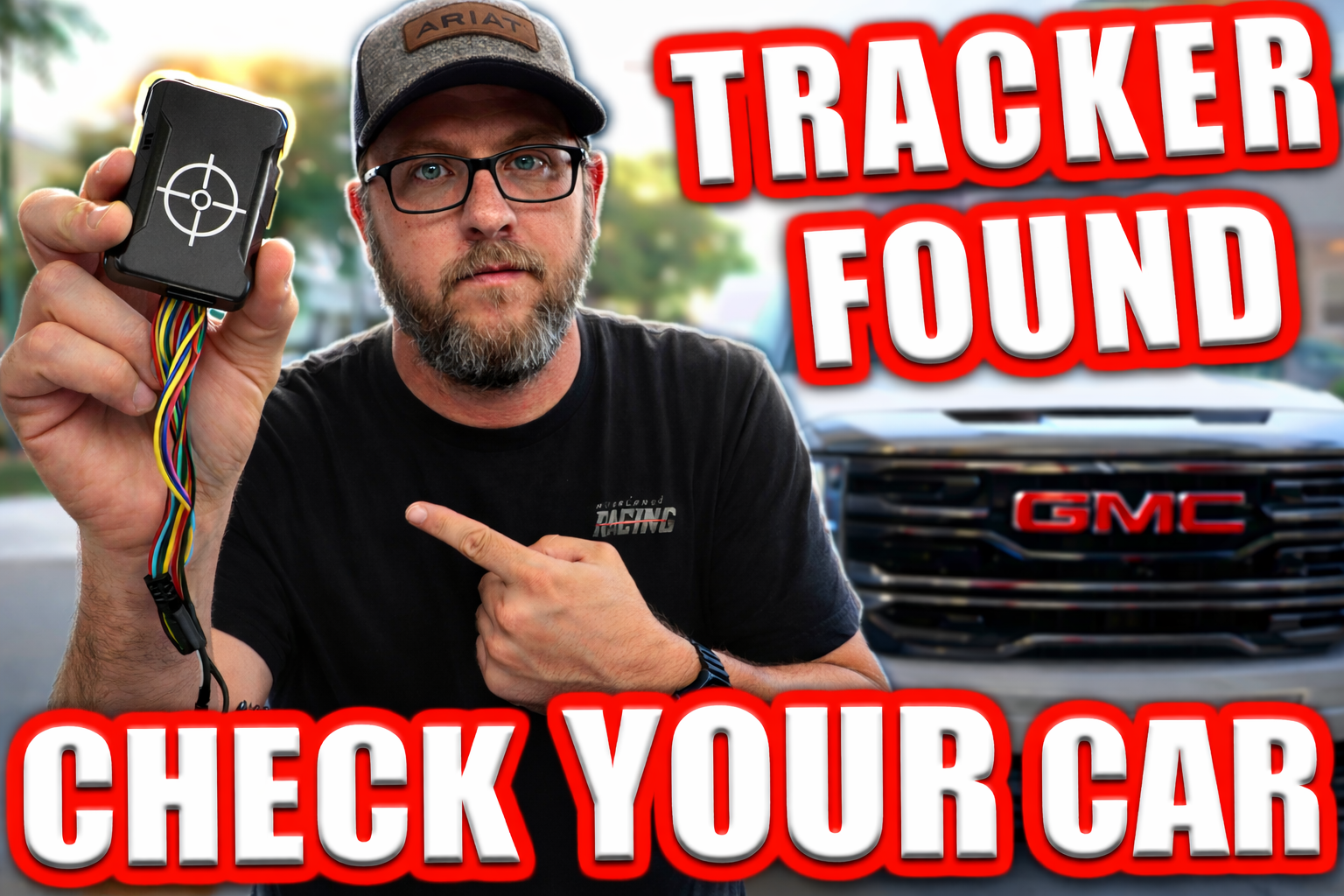
Two videos on my YouTube channel about hidden GPS trackers installed in vehicles crossed a combined 1.5 million views. Thousands of comments followed, many repeating some version of the same sentence:
“I had no idea this GPS tracker was in my car.”
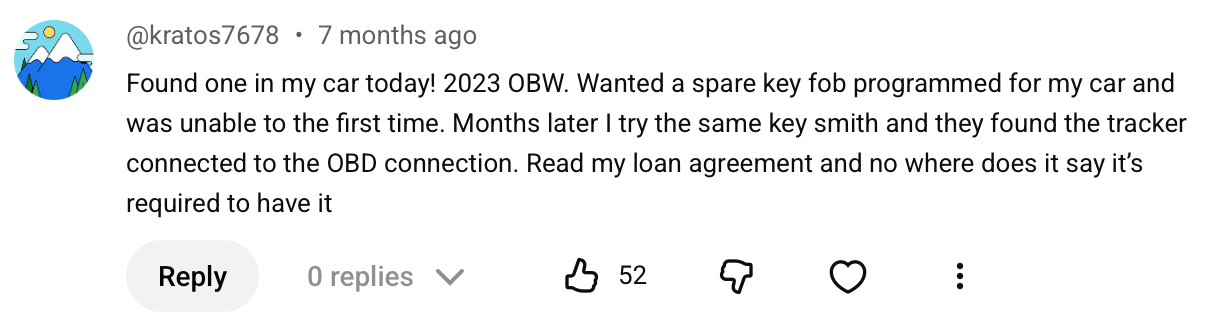

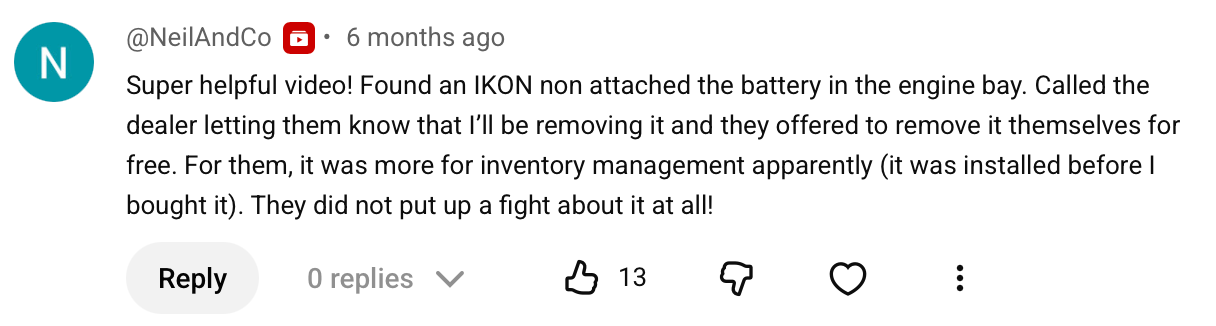


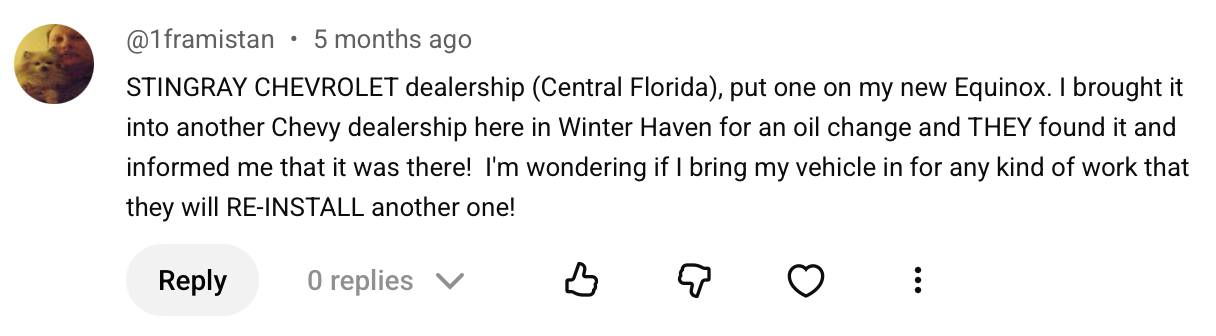
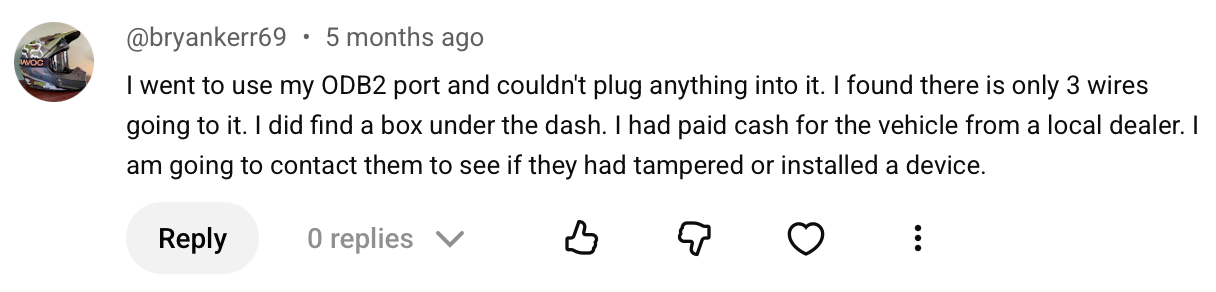

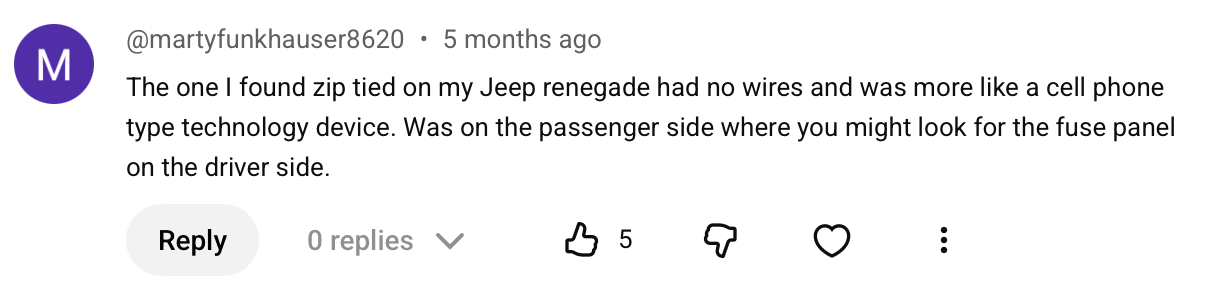
These reactions should be surprising. Sadly, it isn’t.
The attention makes sense because the videos confirmed a sad reality people already thought. In my experience, and based on years of consumer complaints and common buyer sentiment, many dealership sales models rely on pressure, selective disclosure, and fatigue-driven decision making. That usually means more add-ons, more money financed, over more years, at a higher interest rate than necessary, all while smiling and acting like your buddy.
"Let me show you our service department,” they say, as if anyone has ever gone in for service and thought, Wow, this is amazing. In reality, it’s almost always a waiting room reminiscent of a fancy DMV complete with the same turnstile, take-a-number treatment. No VIP experience. You’re lucky to get bland coffee, stale donuts, and a polite “sorry, we don’t have a loaner.”
Buying a car frequently feels less like a transaction and more like being forced to participate in a bad four-hour performance you never asked for, just to buy something you would much rather purchase online with clear pricing and no theatrics.
So this brings us to dealer add-ons, maybe the most theatrical part of the entire car-buying experience. The finance office, where you are already tired, invested, and just want the process to end. Suddenly, a stack of “optional” products appears as if they were always part of the deal. Their smiles get bigger, as if they’re trying to coax your frown into joining them. Overpriced tint, invisible ceramic coatings, plastic bedliners, nitrogen tires, and interior protection packages quietly inflate the number. It’s all “sold” through fatigue and pressure rather than value, and we ALL know it.
Dealer-installed GPS trackers fall into this same add-on category, but with far more serious consequences. Most add-ons are just overpriced, one-time gotchas. GPS trackers introduce ongoing surveillance, data collection, and third-party access that has nothing to do with operating the vehicle. I focus on iKon Technologies here because it is what I personally experienced, but they are just one name among many OBD-II port GPS devices. The issue is not a single vendor. It is the pattern. This goes beyond inflated tint or underwhelming add-ons and points to a new reality where add-ons are no longer passive products, but ongoing systems that create leverage and recurring value long after the sale.
This is something different.
This goes beyond selling a $700 add-on you did not need and quietly rolling it into an eight-year loan. It is about creating the potential for ongoing value to the dealer by leveraging your data long after the sale is complete. Once you do the math, it starts to feel like pigs get fat, hogs get slaughtered situation.
Why This Feels Familiar
Comedian Shane Gillis has pointed out how absurd it is that car buying remains one of the last major purchases where chaos and dishonesty are treated as normal. You can buy a shirt or a TV at a set price, but when you buy a car, you enter a room full of dudes with goatees and bracelets whose entire job is to "fib". It's mayhem dressed in polos and khakis delivering a steady stream of half-truths delivered as casually as possible.
Whether you agree with that characterization or not, the joke resonates because it reflects a widely shared perception. And that same environment of normalized deception is exactly how dealer-installed GPS trackers quietly slipped into the process. When consumers already expect pressure, confusion, and selective honesty, it becomes easy to bury GPS surveillance under vague product names and rushed signatures.
The whole thing feels less like a sophisticated scheme and more like watching a clever six-year-old perform a magic trick with a cheap Amazon magic kit. You already know how the trick ends. But while you’re politely watching, they sneak an extra cookie you already said no to. The trick isn’t impressive. It just works because you’re tired, distracted, and ready for it to be over.
Once you see it that way, the trackers stop feeling like an isolated issue. They feel like a predictable outcome of an industry that has long relied on information overload and social engineering to move inventory.
The Quiet Add-On GPS Surveillance Built Into the Car Buying Process
Vehicles frequently sold today leave dealership lots with dealer-installed GPS tracking devices already in place. These devices are sold under vague labels like “vehicle security,” “dealer connect,” or “anti-theft protection,” with prices ranging from $500 to over $1,000. In my experience, the explanation, if one is offered at all, is shallow, unclear, and buried under asterisks and fine print in one of the many “and this document says…” signatures you are rushed through without a real opportunity to read or understand what you’re agreeing to.
What buyers are rarely told is that these dealer-installed GPS trackers are continuously tracking a vehicle’s location, potentially feeding that data back to the dealer, and operating under extremely broad Terms and Conditions and Privacy Policies that allow far more data collection and sharing than most people would reasonably expect. According to Ikon Technologies’ own Privacy Policy, this can include precise geolocation, travel direction, mileage, device identifiers, account details, and app usage data. That information may be shared with affiliates, service providers, business partners, dealers, and, under certain conditions, law enforcement. It may also be used for marketing purposes by both the vendor and the dealership. The policies further allow disclosures to comply with legal requests, respond to claims, or situations the company deems an emergency, while explicitly limiting liability and requiring arbitration-only dispute resolution.
For what, exactly? In most modern vehicles, these same functions are already provided by the OEM through factory-connected systems that are often more robust, buried deeper in the vehicle and harder for thieves to disable, more transparent to the owner, and governed by tighter, more heavily scrutinized terms. The aftermarket tracker simply adds another layer of surveillance, another set of policies, and another group of parties with access to sensitive data.
This becomes especially clear when you look at the so-called “warranty benefit” used to sell these devices:
This is not a traditional insurance policy. There is no cash payout. What’s offered instead is essentially dealer store credit, not money the consumer controls, and it doesn’t allow you to shop elsewhere.
In practice, this means the dealer who sold you the tracker now controls the pricing and terms of your replacement vehicle at the exact moment you have the least leverage. The “warranty” effectively becomes another dealer-protected margin. At that point, they’re playing with house money.
The consumer takes on the surveillance and data-sharing risk. The tracking company limits its liability. And the dealer keeps the advantage from start to finish.
In iKon’s Authorized Dealer Terms and Conditions, there is a performance clause that allows the company, at its discretion, to invoice the dealer $59 per unsold installed device if certain registration targets are not met. That amount includes 12 months of platform access, functioning as a defined internal charge when an installed device is not ultimately sold to a consumer.
Even without alleging impropriety, the existence of a $59 internal recovery cost should reasonably prompt consumers to question the value proposition of a $500–$1,000 dealer-installed add-on. If the same device carries materially different valuations depending on whether it is sold to a consumer or retained by the dealer, it raises fair questions about how much of the retail price reflects hardware or service costs versus margin, incentives, and sales structure.
Why This Became Real for me
I discovered that GPS tracking devices had been installed in vehicles owned by me and my wife. The vehicles were purchased from two unrelated dealerships in the greater Phoenix area. In neither case was the installation of a third party GPS unit clearly disclosed or understood. The devices appeared on paperwork under vague line items that never referenced GPS tracking. When I attempted to negotiate them out of the deals, I was told they could not be removed because they had already been installed, framed as if this were a permanent modification to the vehicle.
It wasn’t.
The device is plugged into the OBD-II port and can be removed in seconds without tools or any negative impact to the vehicle by a toddler.
Once I accessed the system, the scope of what was being collected became immediately clear. I could see everywhere my truck had gone for weeks before I ever purchased it. Every test drive. Every stop. That single capability fundamentally reframed how I viewed the car-buying process.
I know this is a long read. What follows is where the potential implications become harder to ignore.
Potential Risks Worth Examining
Once you understand how this data can be accessed, the risk profile changes entirely. This stops being about theft recovery or convenience and becomes a much bigger question about visibility, control, and boundaries. If a system allowed me to see vehicle location history before a car was sold, is it unreasonable to ask whether similar access could exist after the sale? If location data was being collected, stored, and reviewed during test drives and dealer inventory use, what mechanisms actually guarantee that access is fully revoked the moment ownership changes hands? These are reasonable questions:
How confident should a buyer be that access truly ends at the point of sale?
If pre-sale location history is accessible to the buyer after purchase, what specifically guarantees that post-sale location data is not accessible to the dealer? Is access explicitly revoked, audited, and enforced, or is that simply assumed?What happens if a dealership employee finds your spouse attractive? Can they see when a vehicle arrives home, when it leaves, whether it’s parked overnight, or when it’s regularly gone during the day, how many real safeguards exist to prevent misuse?
Is location data sold and used in local “marketing”?
Does this open the door to geofencing and behavioral targeting, not just from large corporations tracking online activity, but at a local level as well? If a neighborhood pizza shop partners with a local dealership and knows exactly when your vehicle is five miles from home every Friday evening, does it still need to guess when to email you pizza specials?
This is an illustration of what becomes possible when location data exists, not an allegation that any dealership or vendor is currently doing this.
Consider the math as an ongoing partnership rather than a one-time campaign. Imagine a neighborhood pizza shop pays a local dealership $5,000 per year for access to location-based marketing tied to the last 500 minivans the dealer sold. Minivans mean families. Families buy pizza.
If even a small fraction of those households respond, the numbers quickly add up. At an average $35 order, the pizza shop would only need around ten to twelve additional Friday night orders per week to break even on a $5,000 annual data partnership. Over a full year, that same targeting could drive 500 to 700 incremental orders, translating to roughly $17,500 to $24,500 in added revenue. Even after food and labor costs, that represents a strong return on a relatively small spend. The targeting does not need to be aggressive or clever. It only needs to be precise. Once location data removes the guesswork, the return largely takes care of itself.
Zooming out further, if that same dealership sells similar marketing partnerships to 50 local businesses such as pizza shops, gyms, HVAC companies, home security providers, lawn care services, or roofing companies, the dealership could be generating $250,000 per year in high-margin data revenue from vehicles that were already sold.
At that point, the car is no longer just a product. It becomes a rolling data asset, and the consumer is monetized repeatedly without ever clearly opting in.
Where does data go once it leaves the GPS Manufactures ecosystem?
Even if data isn’t technically “sold,” who can access it? Contractors, analytics vendors, third-party partners?
How strong are the safeguards, and how well are those parties vetted? Once location data enters loosely governed third-party systems, is control lost?
What happens if conflicts enter the picture?
Imagine a post-sale dispute: missing accessories, a denied warranty claim, a heated exchange. If a frustrated individual has access to historical location data, how small is the leap to a real-world confrontation? A knock on your door from someone who knows the car went to your house on a test drive two days before they bought it. Where are my floor mats?
How transparent is law enforcement access in practice?
Many policies allow sharing of location data with law enforcement under broad conditions, sometimes without a warrant and sometimes without notifying the vehicle owner. Even when justified, how would a consumer ever know that access occurred?
What happens when vehicles change hands?
If a vehicle is traded in or sold used with an aftermarket tracker still installed, what prevents the prior owner from retaining access intentionally , or accidentally
What if they left their sunglasses in the car and still have a spare key?
What if they decide they still love that car and take it back from your driveway?
How does this intersect with other surveillance systems already in the wild?
These trackers don’t exist in isolation. They increasingly coexist with other systems through partnerships, shared vendors, or parallel data access.
Companies like Flock Safety deploy automated license-plate readers across neighborhoods, parking lots, apartment complexes, and retail centers. Taken together, what are these systems tracking as a whole? (If you haven’t already, go down the Flock YouTube rabbit hole.)
What about vehicle health and ownership costs?
How does an always-on aftermarket device creating parasitic draw factor into battery longevity? If that draw contributes to premature battery failure, who ultimately absorbs the cost? And if batteries are replaced under OEM warranty while a dealer-installed third-party device contributed to the failure, is that something manufacturers should be accepting warranty claims for? I could argue the dealer should be covering the cost of that battery replacement.
None of these scenarios require conspiracy. They don’t require assuming bad intent across an entire industry. They only require capability without meaningful constraint, paired with systems that quietly collect far more than the buyer understands.
That’s the real issue here. Not what these trackers are marketed to do, but what they make possible once the data exists and is governed by permissive terms most consumers never read, never negotiate, and never truly consent to.
The Bottom Line
The most unsettling part of all of this is not the technology itself. It’s how quickly the conversation gets shut down.
Those responses feel practical, even reasonable, but they miss the point entirely. And that is exactly why they’re dangerous. The moment every new layer of surveillance is justified by pointing to the last one, we stop evaluating whether something should exist at all. We only argue about how inevitable it is.
This IS the line Orwell was warning about. Not a single all-seeing authority, but a society that defends surveillance for convenience, shrugs at consent, and treats erosion of privacy as the cost of doing business.
- Yes, your phone tracks you.
- Yes, OEM systems collect data.
But those facts are not a permission slip for adding more tracking, more opaque terms, and more parties with access to sensitive location data, especially when it is quietly bundled into a purchase you cannot realistically avoid.
Normalization is the real threat.
Once people stop asking who benefits, who controls access, and when it ends, surveillance stops being a tool and becomes background noise. At that point, there is no meaningful consent, only resignation.
I worry that a large portion of society is already there. Too tired to fight it. Too conditioned to question it. Too accustomed to being told that resistance is pointless. But education still matters.
All any of us can do is slow the process down by making it visible again. By pointing out where the incentives actually lie. By explaining what people agreed to without realizing it. By reminding consumers that “everyone does it” is not the same thing as “it’s acceptable.”
Technology isn’t the enemy. Apathy is.
I’ve linked several videos below that explore this issue in more depth. Some document my own experience. Others examine the broader surveillance ecosystem these devices now live inside. If this topic resonates with you, they’re worth your time.
Because the scariest part of an Orwellian future isn’t that it’s imposed on us. It’s that we walk into it willingly, tell ourselves it’s normal, and stop asking questions at all.
This article is an op-ed reflecting my personal experience, analysis of publicly available documents, and opinion. My analysis is informed by publicly available statements made by company leadership describing the product as dealer-first in nature, including expressed views that certain vehicle and customer data collected through OEM-connected vehicle apps is not shared with dealerships, that such data should be accessible by the dealer, and that the company prioritizes initiatives only where there is clear dealer benefit. I also reference and rely on the company’s published Terms and Conditions and Privacy Policies. This article does not allege illegal conduct by any individual dealership, employee, or vendor. Described scenarios are illustrative of potential risks and system capabilities, not claims of current misuse.
Where to look for the hidden GPS in your vehicle
Sam Mahrouq, CEO of Ikon Technologies, discusses the company’s dealer-first philosophy, including views on vehicle data access and the role dealerships play in the connected-car ecosystem.
Barton Harris, VP of Strategic Partnerships at Ikon Technologies, explains the company’s dealer-first philosophy and how Ikon evaluates initiatives based on direct dealer benefit.